
Before the “Enlightenment” in the 1700s, reality was understood by everyone for thousands of years as being layered, hierarchical and spiritually charged. There used to be no concept of a secular space without spiritual activity.
What we think of now as decorative art around the borders of their maps was actually their description of how the world was positioned in the whole cosmos.
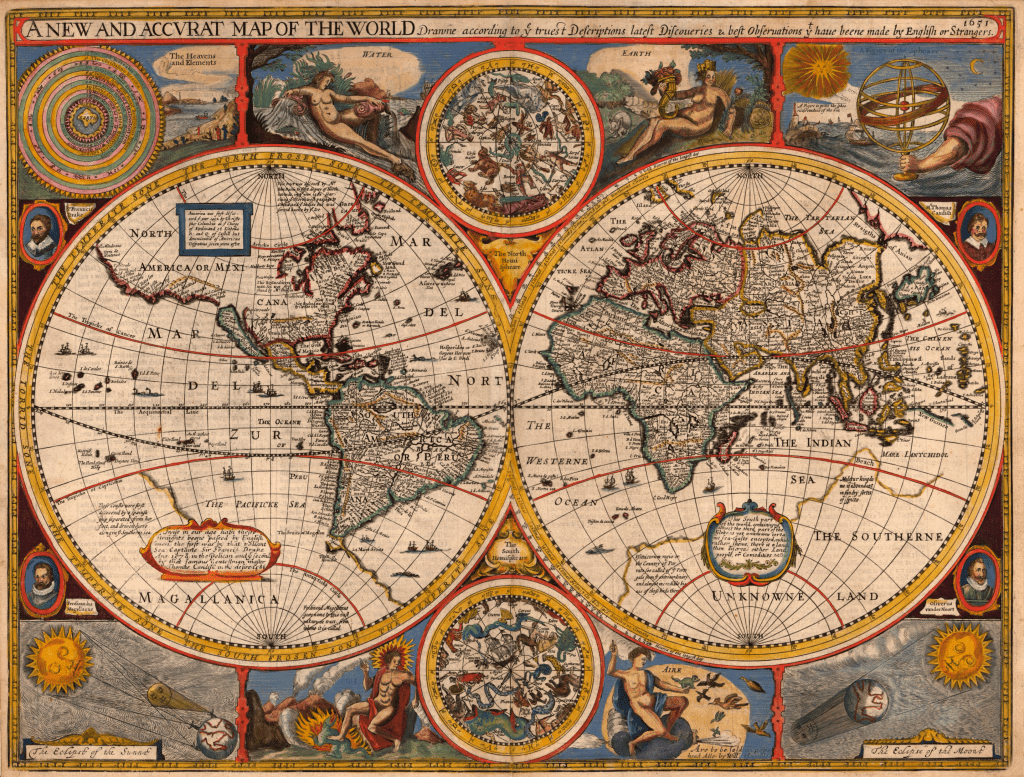
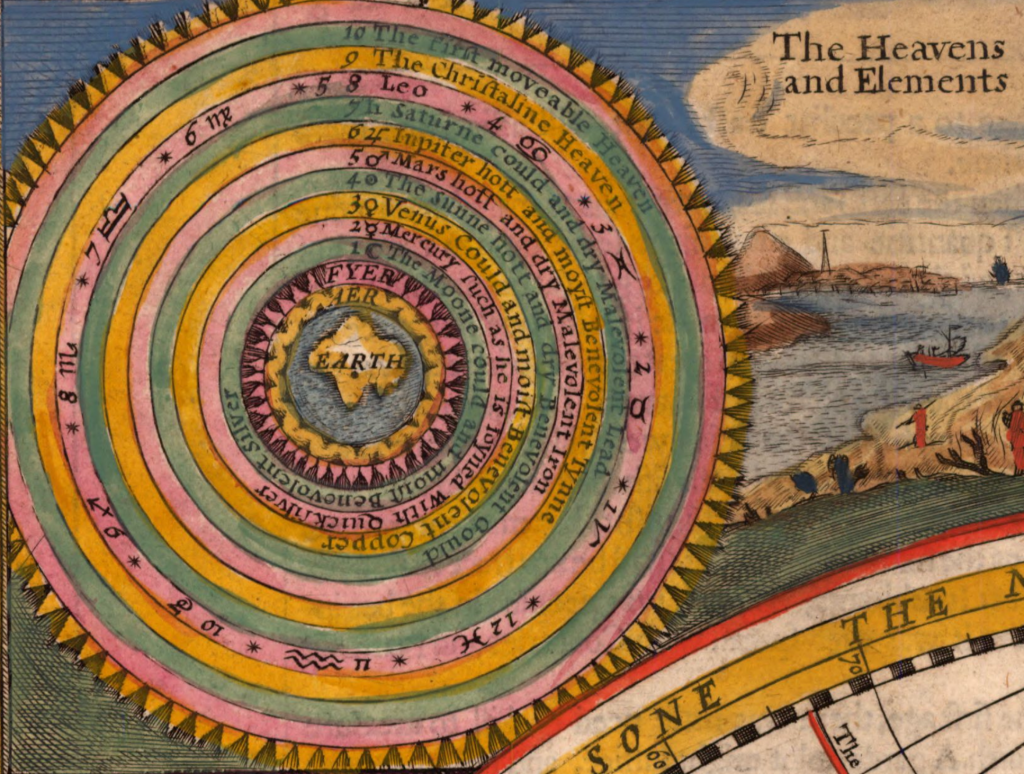
This map based on John Speed’s atlas personifies the four elements: earth, water, air and fire. The sun and moon have faces. The constellations have names and exert influence. But let’s focus in on “The Heavens” at the top left.
It shows 10 layers of the heavens, starting with the “moon, cold and moist” and ending with “The Christaline Heaven” and “The first moveable Heaven” (which means, the primary source of the movement of the heavens). Sometimes there’s one more outer layer included: the Empyrean Heaven, which is God’s realm of immobile pure light.
These days, we think of heaven as one thing, often as a destination. The Bible is more interesting.
- “In the beginning God created the heavens and the earth.” – Gen 1:1
- “Behold, to the LORD your God belong heaven and the heaven of heavens, the earth with all that is in it.” – Deut 10:14
- “the heaven of heavens cannot contain You” – 1 Kings 8:27
- “The heavens, even the highest heavens, cannot contain you.” – 2 Chr 6:18
- “Is not God in the heights of heaven?” – Job 22:12
- “to him who rides across the highest heavens” – Ps 68:33
- “The highest heavens belong to the Lord, but the earth he has given to mankind.” – Ps 115:16
- “Praise him, you highest heavens” – Ps 148:4
- “You made the heavens, even the highest heavens, and all their starry host, the earth and all that is on it, the seas and all that is in them.” – Neh 9:6
- “Hosanna in the highest heaven!” – Mt 21:9
- “Glory to God in the highest heaven” – Lk 2:14
- “I know a man in Christ who… was caught up to the third heaven.” – 2 Co 12:2
- “He… ascended far above all the heavens” – Eph 4:10
In the Hebrew Old Testament, heavens is always in the plural form. In the New Testament, the writers collided with Greek thinking, where heaven is singular. So they often contextualized it for their audience. For example, Matthew often uses the singular, but whenever he talks about the kingdom, he makes sure heavens is plural, like this:
- “Repent, for the kingdom of the heavens has come near” – Mt 3:2
Heaven (singular) can sound like a place. Where as “the heavens” is actually levels of authority. Think of it like Washington vs the federal government. You could get confused and think Washington is just a place, a destination, even though it has a voice: “Washington announced today….” But the federal government sounds more analogous to “the kingdom of the heavens”. It’s governmental.
 Odd Sense of Zero
Leave a comment