
My wife’s away this week cooking at camp. She’s the one who tethers me to the ground, so without her I’m floating around at 30,000 feet, predictably exploring the kingdom of God through a mathematical model called Game Theory. I’m looking forward to her returning and bringing me back to earth, but while I’m here I’ll invite you to join me.
A famous game theory example is the “Prisoner’s Dilemma”. In 1980 a political scientist invited the world’s leading game theorists to submit their best strategies as computer programs that would play each other in a rock-paper-scissors kind of format, but with only two options and various points:
| We’re both nice | Me: 3 | You: 3 |
| We’re both mean | Me: 1 | You: 1 |
| I’m nice, you’re mean | Me: 0 | You: 5 |
| I’m mean, you’re nice | Me: 5 | You: 0 |
You can see if you only play once, you should choose “mean”, because you’ll get 1 or 5 points, where choosing “nice” gets you 0 or 3 points. But in the tournament they played 200 rounds against each competitor. The strategies that consistently won shared these qualities:
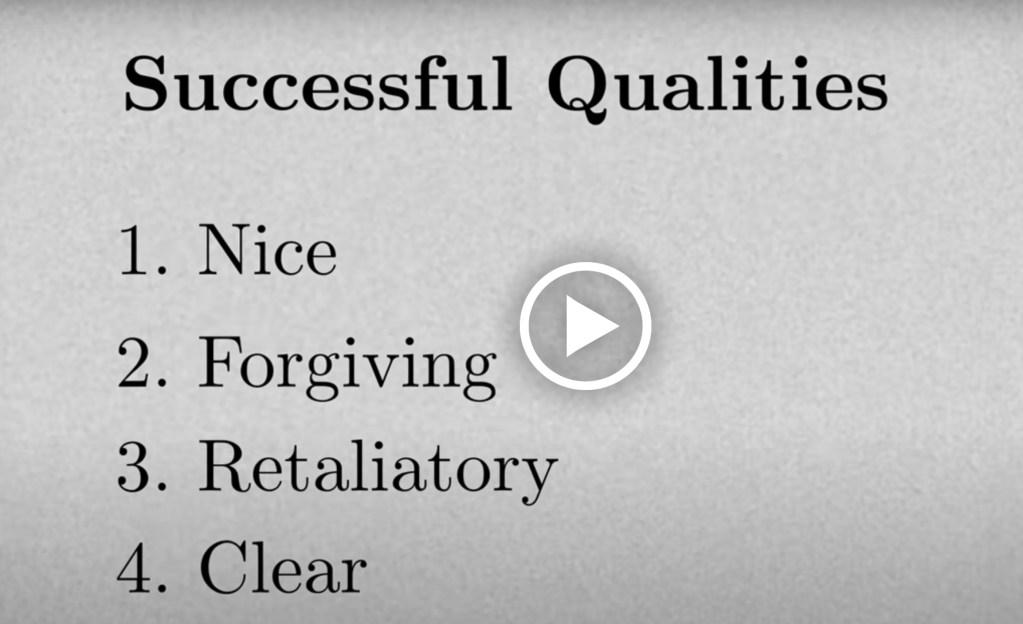
- Nice – they tried to cooperate, so each of them would get 3 points each round instead of 1
- Forgiving – if their competitor was mean, they didn’t hold a grudge, and tried to get back to being nice
- Retaliatory – they weren’t pushovers; if their competitor was mean, they were mean back once, but then quickly went back to being nice and forgiving
- Clear – they acted in a simple and consistent manner, so their opponent didn’t feel like every round was a brand new experience (where it’s better to pick “mean”)
It sounds like how God interacted with the Israelites in the Old Testament. In fact the best strategy was literally referred to as “an eye for an eye” in the video. Copying the last player’s move won every tournament.
 Odd Sense of Zero
Leave a comment