
If you have an organization, you can use the Mission Strategy Map to understand its purpose. Reflecting on your organization’s story using the 9 stages clarifies your mission, values, vision, etc. You can tell who you are and what you’re doing by who you’ve been and what you’ve done.
The Map helps you translate your history into a strategic profile, not based on ideas you’ve come up with, but based on how God has been working with you up till now.
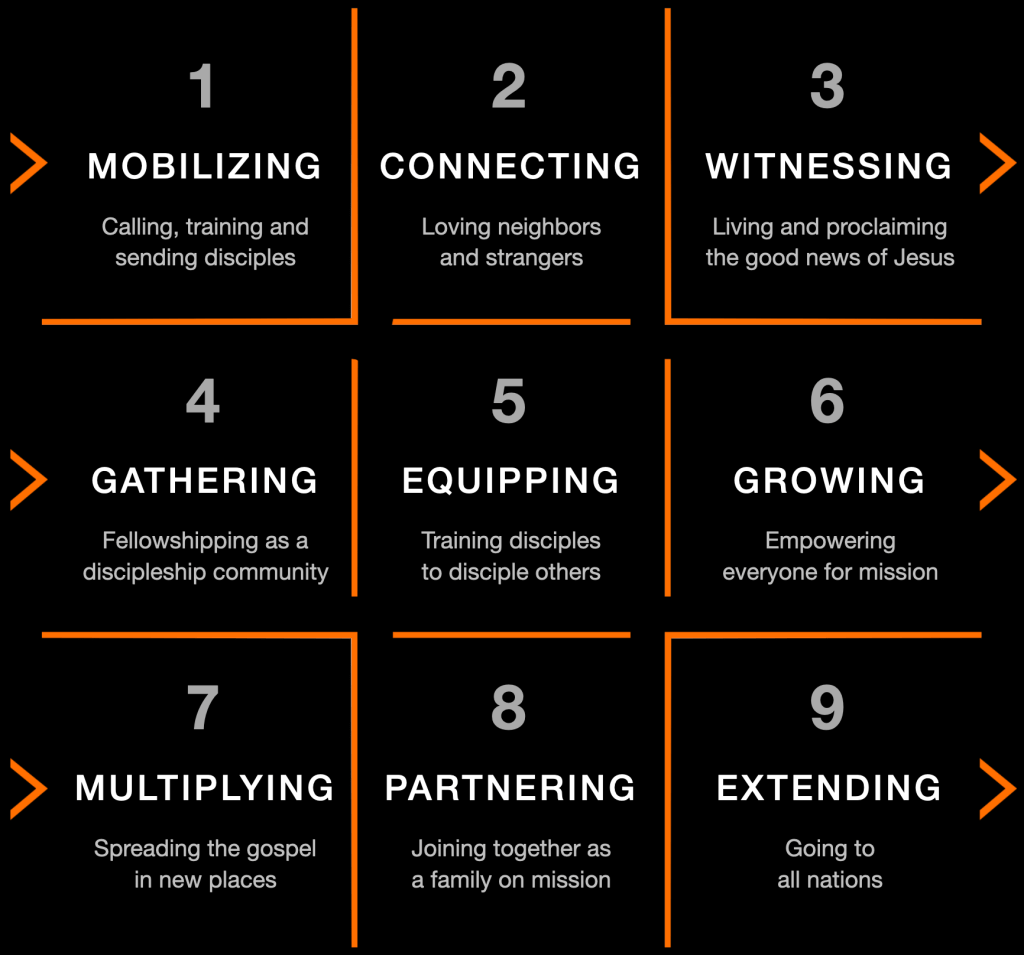
1. Identify your Stages
Things develop naturally. You can only reproduce who you are, what you’ve done and what you’ve experienced. In some sense, you’re limited to those constraints. In another sense, you’re destined to reproduce them.
The stages of development have a natural pace. You can’t skip stages, speed them up, or somehow freeze time until you feel ready for the next one. Each stage typically takes about the same amount of time to complete, so you can roughly line up your own history with the stages of the Map.
Think through the key events and shifts in your ministry’s development, and match them to the stages on the Map. Here are some things to look for from an organizational perspective:
- Mobilizing – getting it going
- your initial cause
- inception of idea; the first try
- doing the obvious thing
- Connecting – becoming one
- working things through
- internal tension; hidden issues
- conflicting priorities
- Witnessing – a taste of the goal
- successful initiatives; positive feeling
- getting people involved in simple ways
- letting it get messy as it grows
- Gathering – managing it
- clarifying oversight
- setting up for the longer term
- organizing the people
- Equipping – building up people
- personally developing the team
- team projects and initiatives
- learning to delegate even when they make mistakes
- Growing – making an impact
- measurable outcomes; objective evaluation
- mostly difficult season: “confront the brutal facts”
- distinguish: busy or good?
- Multiplying – several locations
- know unique contribution, real purpose
- big picture thinking; align everything
- relaxed and confident, regardless of how things look
- Partnering – other organizations
- get help to fulfill dream
- other ministries need you
- bend on things that don’t compromise your purpose
- Extending – doing it all again somewhere else
- multi-site multiplication
- significant influence
- can’t directly supervise
2. Identify your Strategic Profile
You can see your strategy by what you did. First, you discover your mission, then you have to work through your values, then you start seeing your vision appearing, etc.
Go through each of your stages and mine out your strategic profile, defining each one based on what you experienced in that stage. For stages you’re not in yet, make your best guess and we’ll refine them later.
- Mobilizing → Mission
- everything has to build on only one, clear foundation
- what casual observers think you’re doing
- state the obvious (no surprises or complexity)
- Connecting → Values
- narrow it down to just two
- both equally important, yet seem incompatible
- example: “customer is #1” and “employees are #1”
- Witnessing → Vision
- how someone in 5-10 years would describe what they see (with their eyes)
- people instantly grasp/like
- present as three things: “this, that and more”
- Gathering → Structure
- draw out your org chart
- simple – just the leaders
- based on current reality
- Equipping → Path
- five steps for your team to develop individuals
- example: invited > attend > join > contribute > lead
- how you get to #6 Results
- Growing → Results
- measure six results = two values x three vision parts
- show what matters to you
- must be numeric (clear)
- Multiplying → Purpose
- “Hedgehog Concept”
- best in the world at? (hint: no one else is trying)
- deeply passionate about?
- Partnering → Partnerships
- four outside groups you expect to cooperate
- outline what you need from them
- what they need from you
- Extending → Reproduce
- nine stages to expand e.g. to other sites or locations
- reflect these 9 stages, but each in 1/9th of the time
- reproduce how you did it
3. Check for Consistency
The 9 stages model provides some ways to ensure congruence:

- Each row and each column should have an identifiable theme that is distinct from other rows and columns.
- Each stage should have equal content, be equally interesting, and contribute equal amounts of value to the strategy.
- Stages 1, 5 and 9 should summarize your ministry. These are the essentials, the primary pieces of your strategy.
- Stage 3: the vision statement is a summary of the top row, middle row and bottom row, implemented in that order.
- Stage 4 should set up people in stage 5 to achieve the outcomes described in stage 6.
- Stage 6 is the most telling: the things you want to measure should be your your 1 mission x 2 values x 3 visions. If those don’t match, adjust stages 1-3.
- Stage 7: the purpose statement is similar to the vision statement, but more ambitious, almost arrogant. It should be a summary of each column.
- Stage 9 should look like all the stages combined. That is, your roll out plant should look like how you rolled it out the first time.
- The corners should be the most visible, and stage 5 should be the least visible from the outside.
- Each stage has content that matches its number: 1 mission, 2 competing values, 3 vision components, 4 parts of the organization, 5 steps for personal development, 6 measurable outcomes, 7 (see next point), 4 key partners x 2 (giving and receiving), 9 stages to reproduce
- Stage 7 is your purpose statement followed by 3 pairs: what you’ve received that cannot be bought, what’s been assembled that cannot be worked for and what you are giving that cannot be sold. (You’ll recognize these as Sabbath principles.)
Things should fall into place naturally. If they really don’t, go back and recalibrate when you started stage #1, or how long your stages are. Do this a few times until you’re really convinced that you can see your strategy appear out of your story.
 Odd Sense of Zero
Leave a comment