
Here we look at the Map from the perspective of teaching and stories from the scriptures. This helps us reflect on each stage as it relates to themes in the Bible.
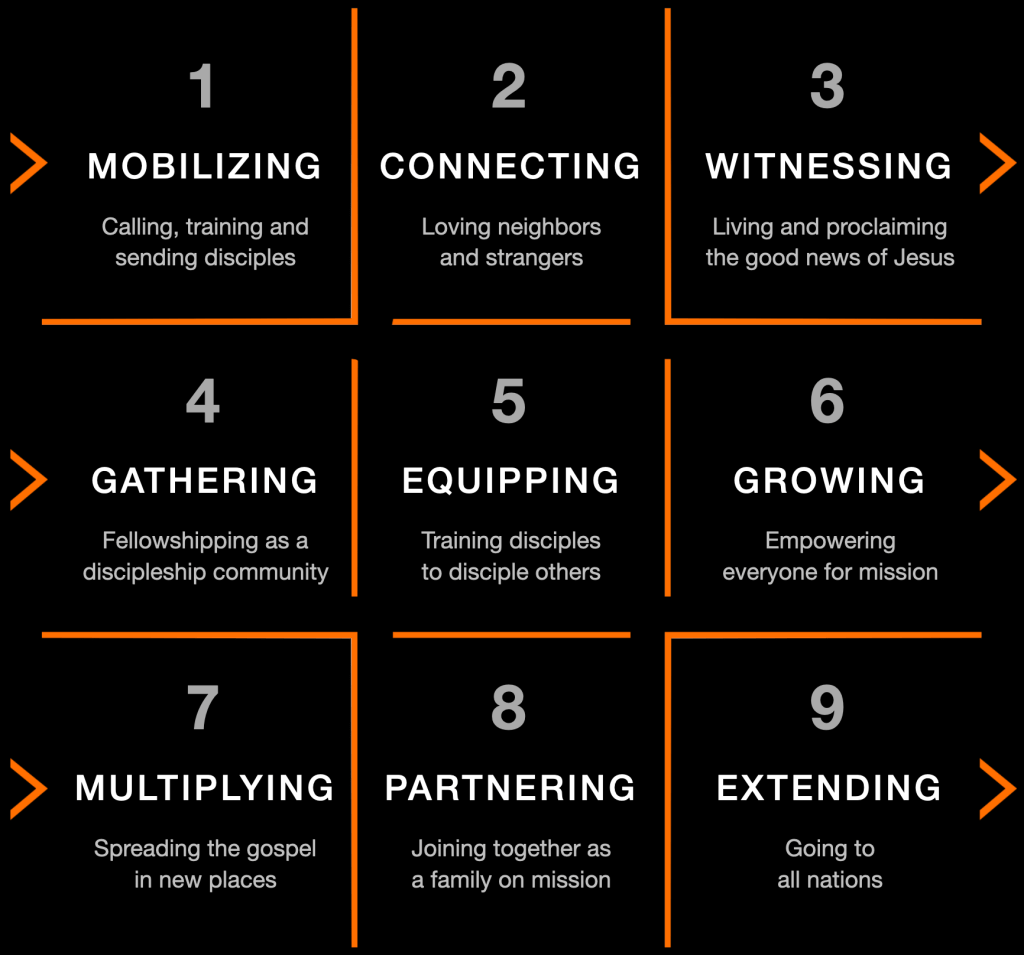
1. Mobilizing
Sent
Then the eleven disciples went to Galilee, to the mountain where Jesus had told them to go. When they saw him, they worshiped him; but some doubted. Then Jesus came to them and said, “All authority in heaven and on earth has been given to me. Therefore go and make disciples of all nations, baptizing them in the name of the Father and of the Son and of the Holy Spirit, and teaching them to obey everything I have commanded you. And surely I am with you always, to the very end of the age.” – Matthew 28:16-20
This stage is from Not Mobilized (no target people group, no outreach goals, no mission vision) to Mobilized (joined in leading a people group through the stages of the Mission Strategy Map). This is the shift into mission.
Love
For God so loved the world that he gave his one and only Son, that whoever believes in him shall not perish but have eternal life. For God did not send his Son into the world to condemn the world, but to save the world through him. – John 3:16-17
Love needs an object. Mobilization is not just training people for mission. It’s sending them to a specific group of people who don’t know Jesus. If you or your church can’t name the people you’re sent to, you’re not mobilized. We’re talking here about mobilization in the context of mission. If the people you are sent to are Christians (like, raising awareness, fundraising, starting prayer groups) then you are not mobilized for mission. Who is the object of your love?
We love the world. That’s completely different from “change the world”. Anyone who sees that someone is trying to change them feels condemned. And that’s not why Jesus came. We love people with the faith that God will somehow draw them to himself.
Fruitful
The farmer sows the word. Some people are like seed along the path, where the word is sown. As soon as they hear it, Satan comes and takes away the word that was sown in them. Others, like seed sown on rocky places, hear the word and at once receive it with joy. But since they have no root, they last only a short time. When trouble or persecution comes because of the word, they quickly fall away. Still others, like seed sown among thorns, hear the word; but the worries of this life, the deceitfulness of wealth and the desires for other things come in and choke the word, making it unfruitful. Others, like seed sown on good soil, hear the word, accept it, and produce a crop—some thirty, some sixty, some a hundred times what was sown.” – Mark 4:14-20
The goal for each Christian community is to be fruitful. When the obstacles are overcome, and with patience like waiting for a crop, we expect 30, 60 or 100 times what was sown. You can tell if your church is content hoping for single digit percentage annual growth by the way it is structured. Can you imagine 100x more baptisms? 100x more members? 100x more locations? 100x more what? What are you hoping for?
Death
Very truly I tell you, unless a kernel of wheat falls to the ground and dies, it remains only a single seed. But if it dies, it produces many seeds. – John 12:24
The route to multiplication is not continuous improvement through training, equipping and effort. It is to die. The essential element of mobilization is calling people to let go of their lives to join God’s mission to love, reconcile and transform nations.
Mobilize
While they were worshiping the Lord and fasting, the Holy Spirit said, “Set apart for me Barnabas and Saul for the work to which I have called them.” So after they had fasted and prayed, they placed their hands on them and sent them off. The two of them, sent on their way by the Holy Spirit, went down to Seleucia and sailed from there to Cyprus. When they arrived at Salamis, they proclaimed the word of God in the Jewish synagogues. John was with them as their helper. – Acts 13:2-5
You may be affirming the call of leaders to reach new nations, or sending people like John to help them. You may have various ways to prepare them to go. What we see here is that the Holy Spirit determined the overall assignment, and we joined Him by sending people.
2. Connecting
Unity
“My prayer is not for them alone. I pray also for those who will believe in me through their message, that all of them may be one, Father, just as you are in me and I am in you. May they also be in us so that the world may believe that you have sent me. I have given them the glory that you gave me, that they may be one as we are one— I in them and you in me—so that they may be brought to complete unity. Then the world will know that you sent me and have loved them even as you have loved me.” – John 17:20-23
This stage is from Not Connected (don’t know the unbelievers, don’t know Christians who do, don’t understand them or their context) to Connected (unbelievers as friends, networked with other Christians, some understanding of their language and culture). This is about being with unbelievers.
Joy
Remember those earlier days after you had received the light, when you endured in a great conflict full of suffering. Sometimes you were publicly exposed to insult and persecution; at other times you stood side by side with those who were so treated. You suffered along with those in prison and joyfully accepted the confiscation of your property, because you knew that you yourselves had better and lasting possessions. So do not throw away your confidence; it will be richly rewarded. – Hebrews 10:32-35
We’re not focusing on immediate results, or what “we” can accomplish. We don’t interpret difficult circumstances as failures. We suffer willingly and joyfully because we are confident in God’s promises and his ability to bring them about. This is not about what my organization is doing. We rejoice in whatever God is doing.
Favor
Make it your ambition to lead a quiet life: You should mind your own business and work with your hands, just as we told you, so that your daily life may win the respect of outsiders and so that you will not be dependent on anybody. – 1 Thessalonians 4:11-12
Often your presence speaks louder than words, especially before people have a chance to get to know you. They want to know your life has credibility, not just your message.
Humility
Sing and make music from your heart to the Lord, always giving thanks to God the Father for everything, in the name of our Lord Jesus Christ. Submit to one another out of reverence for Christ. – Ephesians 5:19-21
There is joy and freedom in trusting God. We don’t send missionaries in to lead the locals. Or expect missionaries to just follow the locals. We also don’t expect them to work as equals. We submit to each other in appropriate areas. Local believers who are leading their family and friends to Christ carry the mission vision and strategy for their people. Foreign missionaries often come representing established churches with generations of experience following Jesus. When we submit to each other because we believe God is actually leading, it becomes a joy.
Connect
After this, Paul left Athens and went to Corinth. There he met a Jew named Aquila, a native of Pontus, who had recently come from Italy with his wife Priscilla, because Claudius had ordered all Jews to leave Rome. Paul went to see them, and because he was a tentmaker as they were, he stayed and worked with them. – Acts 18:1-3
Paul went to a new city and connected with some recent immigrants who had the same job. You may have many different strategies, including language learning, when you enter a new area. The point is to connect with real people and relate to them in their context.
3. Witness
Proclaim
At daybreak, Jesus went out to a solitary place. The people were looking for him and when they came to where he was, they tried to keep him from leaving them. But he said, “I must proclaim the good news of the kingdom of God to the other towns also, because that is why I was sent.” – Luke 4:42-43
This stage is from Not Witnessing (not saying “Jesus” out loud in front of unbelievers, not praying with unbelievers) to Witnessing (stories of sharing the gospel with unbelievers that you know, stories of answered prayer). This is about shifting into spiritual conversations as the primary emphasis.
Peace
For God was pleased to have all his fullness dwell in him, and through him to reconcile to himself all things, whether things on earth or things in heaven, by making peace through his blood, shed on the cross. Once you were alienated from God and were enemies in your minds because of your evil behavior. But now he has reconciled you by Christ’s physical body through death to present you holy in his sight, without blemish and free from accusation – Colossians 1:19-22
Salvation is not about well-meaning people accepting new information they didn’t have. We were enemies of God through our participation in sin, and Jesus made a way for us to be at peace with God. It’s changing citizenship into the kingdom of God.
Gospel
“This is what the kingdom of God is like. A man scatters seed on the ground. Night and day, whether he sleeps or gets up, the seed sprouts and grows, though he does not know how. All by itself the soil produces grain—first the stalk, then the head, then the full kernel in the head. As soon as the grain is ripe, he puts the sickle to it, because the harvest has come.” – Mark 4:26-29
Our job is just to preach the gospel, not to make people respond. The word of God multiplies all by itself. God makes it grow. A study done in 2012 of 142 countries (see notes) showed that preaching the gospel statistically made the most positive impact in the last century compared to over 50 other variables.
One Way
Now, brothers and sisters, I want to remind you of the gospel I preached to you, which you received and on which you have taken your stand. By this gospel you are saved, if you hold firmly to the word I preached to you. Otherwise, you have believed in vain.
For what I received I passed on to you as of first importance: that Christ died for our sins according to the Scriptures, that he was buried, that he was raised on the third day according to the Scriptures – 1 Corinthians 15:1-4
Our good news is not clean water, education, friendship, compassion, relief from suffering, money, technology, democracy or sustainable farming practices. Those may accompany any of the stages of the Strategy Map, but they are never the point. We preach Christ crucified, buried and resurrected, so that they can enter the kingdom of heaven.
Witness
After this the Lord appointed seventy-two others and sent them two by two ahead of him to every town and place where he was about to go. He told them, “The harvest is plentiful, but the workers are few. Ask the Lord of the harvest, therefore, to send out workers into his harvest field. Go! I am sending you out like lambs among wolves. – Luke 10:1-3
There are many ways to participate in witnessing, and Jesus invites us into all of them. Go. Pray. See unbelievers as fellow workers. Through the Strategy Map, we see the people we’re reaching as the future workers who will send out workers.
4. Gathering
Empower
One of those listening was a woman from the city of Thyatira named Lydia, a dealer in purple cloth. She was a worshiper of God. The Lord opened her heart to respond to Paul’s message. When she and the members of her household were baptized, she invited us to her home. “If you consider me a believer in the Lord,” she said, “come and stay at my house.” And she persuaded us. – Acts 16:14-15
This stage is from Not Gathered (individual Christians not meeting together, meeting together for other reasons, or meeting together with the missionary leading) to Gathered (regularly meeting under local leadership for the purpose of church). This is about shifting from missionary leadership to local leadership. Paul had to be persuaded to go help this new convert lead her household.
Patience
God is not unjust; he will not forget your work and the love you have shown him as you have helped his people and continue to help them. We want each of you to show this same diligence to the very end, so that what you hope for may be fully realized. We do not want you to become lazy, but to imitate those who through faith and patience inherit what has been promised. When God made his promise to Abraham, since there was no one greater for him to swear by, he swore by himself, saying, “I will surely bless you and give you many descendants.” And so after waiting patiently, Abraham received what was promised. – Hebrews 6:10-15
New leaders rise up slowly. It’s easier to do it ourselves, and it seems like it’s better. But for a movement to multiply it must have local leaders. What you hope for requires patience. Don’t expect someone will take over what you start. You can model leadership, but we’re waiting for local believers to disciple other believers in a group context. Then we have a church with a future.
Church
Paul, a prisoner of Christ Jesus, and Timothy our brother, To Philemon our dear friend and fellow worker— also to Apphia our sister and Archippus our fellow soldier—and to the church that meets in your home: Grace and peace to you from God our Father and the Lord Jesus Christ. – Philemon 1:1-3
When we talk about “church”, it’s not about the form. Someone deliberately discipling their spouse and children is a church. A big building with a paid pastor and hundreds of members is a church. Because church is about someone caring for a group of people in the name of Jesus, and leading them into the larger family of God and our collective mission.
Invitation
The following day we reached Puteoli. There we found some brothers and sisters who invited us to spend a week with them. And so we came to Rome. The brothers and sisters there had heard that we were coming, and they traveled as far as the Forum of Appius and the Three Taverns to meet us. – Acts 28:13-15
Once there are believing leaders, we respond to their invitations. We serve them in the ways that they find helpful. The ministry grows at the pace of their discipleship. Foreigners bringing their ideas often slows down this process through artificial short term success.
Gather
Greet Priscilla and Aquila, my co-workers in Christ Jesus…. Greet also the church that meets at their house…. Greet those who belong to the household of Aristobulus…. Greet those in the household of Narcissus who are in the Lord…. Greet Asyncritus, Phlegon, Hermes, Patrobas, Hermas and the other brothers and sisters with them…. Greet Philologus, Julia, Nereus and his sister, and Olympas and all the Lord’s people who are with them. – Romans 16:3, 5, 10-11, 14-15
Rather than invite more people to your house fellowship, or training a new co-leader, find out who in your group is sharing the gospel and help them start a group with the people who are following them. They will need much less training when it’s just their friends and family.
5. Equipping
Train
You then, my son, be strong in the grace that is in Christ Jesus. And the things you have heard me say in the presence of many witnesses entrust to reliable people who will also be qualified to teach others. – 2 Timothy 2:1-2
This stage is from Not Equipped (the church will fall apart if the pastor leaves) to Equipped (the church leadership team could carry on without their leader). This is about shifting from one leader to many who can lead.
Kindness
Or do you show contempt for the riches of his kindness, forbearance and patience, not realizing that God’s kindness is intended to lead you to repentance? – Romans 2:4
Your leadership team learns to lead people on the path of discipleship not through rules and control, but kindness.
Spirit
The Spirit searches all things, even the deep things of God. For who knows a person’s thoughts except their own spirit within them? In the same way no one knows the thoughts of God except the Spirit of God. What we have received is not the spirit of the world, but the Spirit who is from God, so that we may understand what God has freely given us. This is what we speak, not in words taught us by human wisdom but in words taught by the Spirit, explaining spiritual realities with Spirit-taught words – 1 Corinthians 2:10-13
The reason we can trust the new leaders is because our trust is in the Spirit of God. We are not building a human organization where we need to control the outcomes. Jesus is building his church and we are his servants. As we teach people to hear the voice of God, they learn to walk by the Spirit and not by human wisdom.
Suffering
During the days of Jesus’ life on earth, he offered up prayers and petitions with fervent cries and tears to the one who could save him from death, and he was heard because of his reverent submission. Son though he was, he learned obedience from what he suffered and, once made perfect, he became the source of eternal salvation for all who obey him – Hebrews 5:7-9
We don’t like to admit it, but the best training comes through suffering. So this stage is not just about teaching. It’s about letting God work in people through their trials. Their perseverance by faith equips them for the next stages of growth.
Equip
Remember your leaders, who spoke the word of God to you. Consider the outcome of their way of life and imitate their faith. – Hebrews 13:7
There are many ways to train leaders, including the Missional Leadership Training modules that we’re translating into many languages. But the primary way to equip new leaders is to let them learn from your life.
6. Grow
Commission
As Jesus was getting into the boat, the man who had been demon-possessed begged to go with him. Jesus did not let him, but said, “Go home to your own people and tell them how much the Lord has done for you, and how he has had mercy on you.” So the man went away and began to tell in the Decapolis how much Jesus had done for him. And all the people were amazed. – Mark 5:18-20
This stage is from Not Growing (people are not coming to faith, or the church is only growing through what the leaders initiate) to Growing (people in the church start leading people to Jesus). This is about shifting from leadership-led mission to organic evangelism.
Goodness
Every day they continued to meet together in the temple courts. They broke bread in their homes and ate together with glad and sincere hearts, praising God and enjoying the favor of all the people. And the Lord added to their number daily those who were being saved. – Acts 2:46-47
Would your community notice if your church didn’t exist? Or are you doing something good that they appreciate? Do the people in your church think what you have is good? This is the stage where you can tell if it’s all been about gifted leaders, or the Spirit of God has touched people’s hearts through your community.
Freedom
Now an angel of the Lord said to Philip, “Go south to the road—the desert road—that goes down from Jerusalem to Gaza.” So he started out, and on his way he met an Ethiopian eunuch, an important official in charge of all the treasury of the Kandake (which means “queen of the Ethiopians”). This man had gone to Jerusalem to worship, and on his way home was sitting in his chariot reading the Book of Isaiah the prophet. The Spirit told Philip, “Go to that chariot and stay near it….” Philip began with that very passage of Scripture and told him the good news about Jesus. As they traveled along the road, they came to some water and the eunuch said, “Look, here is water. What can stand in the way of my being baptized?” And he gave orders to stop the chariot. Then both Philip and the eunuch went down into the water and Philip baptized him. – Acts 8:26-29, 35-38
The Holy Spirit will lead the people in your church into encounters with those who are ready to hear the gospel. The growth will likely be messy and exciting. People may get baptized before they’ve gone through all your usual steps.
Accountability
By the grace God has given me, I laid a foundation as a wise builder, and someone else is building on it. But each one should build with care. For no one can lay any foundation other than the one already laid, which is Jesus Christ. If anyone builds on this foundation using gold, silver, costly stones, wood, hay or straw, their work will be shown for what it is, because the Day will bring it to light. It will be revealed with fire, and the fire will test the quality of each person’s work. If what has been built survives, the builder will receive a reward. If it is burned up, the builder will suffer loss but yet will be saved—even though only as one escaping through the flames. – 1 Corinthians 3:10-15
In the midst of all this freedom, there is still accountability. Almost the whole book of 1 Corinthians is correcting different issues that are quite significant. It seems that Paul is comfortable giving others room to build and even make mistakes, but not willing to leave the church in that state.
Grow
But when they opposed Paul and became abusive, he shook out his clothes in protest and said to them, “Your blood be on your own heads! I am innocent of it. From now on I will go to the Gentiles.” Then Paul left the synagogue and went next door to the house of Titius Justus, a worshiper of God. Crispus, the synagogue leader, and his entire household believed in the Lord; and many of the Corinthians who heard Paul believed and were baptized. – Acts 18:6-8
It’s OK to grow. If one group of people rejects you, you can find someone who is ready to receive this good news. Like Jesus’ parable of the banquet invitations, go find anyone, like the poor and the lame. When someone in your church is fruitful, it’s time to contemplate what your doing as leaders to facilitate them, and what you’re doing that is irrelevant to them.
7. Multiplying
Reproduce
“I am the vine; you are the branches. If you remain in me and I in you, you will bear much fruit; apart from me you can do nothing. If you do not remain in me, you are like a branch that is thrown away and withers; such branches are picked up, thrown into the fire and burned. If you remain in me and my words remain in you, ask whatever you wish, and it will be done for you. This is to my Father’s glory, that you bear much fruit, showing yourselves to be my disciples.” – John 15:5-8
This stage is from Not Multiplying (people are being added, but those people are not adding others) to Multiplying (your small groups are leading people to Christ and discipling them into leading small groups, out to the fourth generation). This is about shifting from addition, which can look like multiplication if you do it fast enough, to multiplication, which is less about an organization and more about a movement. It is the result of abiding in Christ.
Faith
Understand, then, that those who have faith are children of Abraham. Scripture foresaw that God would justify the Gentiles by faith, and announced the gospel in advance to Abraham: “All nations will be blessed through you.” So those who rely on faith are blessed along with Abraham, the man of faith. – Galatians 3:7-9
Someone has to believe God for more than their family, friends or neighborhood. God wants all nations to be blessed and promised that he would do it through us. We’re looking for leaders who believe this is possible for their nation or cultural group.
Multiplication
God blessed them and said to them, “Be fruitful and multiply” – Genesis 1:28
Multiplying is a theme that runs through the entire Bible. It’s the first command. The patriarchs were blessed to multiply. So were Moses, Joshua, David, Solomon and the people of Israel. Jesus commissions his disciples to multiply. The church multiplies in Acts. And in Revelation, there is a multitude. We are here to multiply.
Barrenness
By faith even Sarah, who was past childbearing age, was enabled to bear children because she considered him faithful who had made the promise. And so from this one man, and he as good as dead, came descendants as numerous as the stars in the sky and as countless as the sand on the seashore. – Hebrews 11:11-12
Sometimes it takes so long that multiplication seems impossible. We structure ourselves just to hold on. In the Old Testament barrenness was like being cursed; everyone wanted lots of children. But in our churches sometimes we settle for not having any spiritual children. God has promised that we can multiply through faith and patience.
Multiply
I do not think I am in the least inferior to those “super-apostles.” I may indeed be untrained as a speaker, but I do have knowledge. We have made this perfectly clear to you in every way. Was it a sin for me to lower myself in order to elevate you by preaching the gospel of God to you free of charge? I robbed other churches by receiving support from them so as to serve you. And when I was with you and needed something, I was not a burden to anyone, for the brothers who came from Macedonia supplied what I needed. I have kept myself from being a burden to you in any way, and will continue to do so. – 2 Corinthians 11:5-9
We’re not looking for super-apostles, or trained speakers, or for people charging money. We’re looking for people called by God, and doing what he says regardless of whether we’re behind them or they’re getting paid.
8. Partnering
Together
Then some of the believers who belonged to the party of the Pharisees stood up and said, “The Gentiles must be circumcised and required to keep the law of Moses.” The apostles and elders met to consider this question. – Acts 15:5-6
This stage is from Not Partnered (independent individual churches, a group of churches led by a single leader, or a group of churches that doesn’t connect with the wider body of Christ) to Partnered (a family of churches with group leadership, which is part of the larger church). This is about shifting from a single leader of a church planting movement, to a team of leaders (pastors) who care about all the churches together.
Gentleness
Now about our brother Apollos: I strongly urged him to go to you with the brothers. He was quite unwilling to go now, but he will go when he has the opportunity. – 1 Corinthians 16:12
When apostles, evangelists and church planters have worked so hard for Jesus in their own contexts, sometimes it’s hard to submit to others in a group on mission together. The key at this stage is not to command others, but to find gentler approaches, without laying aside your convictions.
Family
Let us not become weary in doing good, for at the proper time we will reap a harvest if we do not give up. Therefore, as we have opportunity, let us do good to all people, especially to those who belong to the family of believers. – Galatians 6:9-10
We often talk about a family of churches, because we believe that is an accurate paradigm for how we relate to each other. We treat each other like family, brothers and sisters of our Father. We are not in transactional or performance based relationships. Rather we are devoted to each other, not competing, but celebrating others’ victories. The history of the MB’s includes hundreds of years of persecution and fleeing to other cultures, so our formation is not around a specific leader, theology, experience or hierarchical structure. It is around being an actual family together.
Openness
I appeal to you, brothers and sisters, in the name of our Lord Jesus Christ, that all of you agree with one another in what you say and that there be no divisions among you, but that you be perfectly united in mind and thought. My brothers and sisters, some from Chloe’s household have informed me that there are quarrels among you. What I mean is this: One of you says, “I follow Paul”; another, “I follow Apollos”; another, “I follow Cephas”; still another, “I follow Christ.” Is Christ divided? Was Paul crucified for you? Were you baptized in the name of Paul? – 1 Corinthians 1:10-13
Though we value our MB heritage, we long for reconciliation between all the denominations. So we are open to serving everyone who calls Jesus Lord and is participating in his mission. We are leading people to Jesus, not trying to start MB churches. But of course the result is often MB churches, because we treat people like family.
Partner
Now about the collection for the Lord’s people: Do what I told the Galatian churches to do. On the first day of every week, each one of you should set aside a sum of money in keeping with your income, saving it up, so that when I come no collections will have to be made. Then, when I arrive, I will give letters of introduction to the men you approve and send them with your gift to Jerusalem. – 1 Corinthians 16:1-3
Partnership is not always about money, but here is an example of the Corinthian churches partnering with the Galatian churches to help the churches in Jerusalem. They worked through the apostles and the elders. Churches were not independent, and there wasn’t just one leader. This is often a difficult stage for the primary leader, but it’s time to form a team that all cares about the whole ministry.
9. Extending
Beyond
Our hope is that, as your faith continues to grow, our sphere of activity among you will greatly expand, so that we can preach the gospel in the regions beyond you. For we do not want to boast about work already done in someone else’s territory. – 2 Corinthians 10:15-16
This stage is from Not Extending (staying inside the same culture, language and geography) to Extending (sending people long-term to different cultures and lands). This is about shifting from your own church planting movement to starting new movements in far away places.
Self-Control
Teach the older men to be temperate, worthy of respect, self-controlled, and sound in faith, in love and in endurance. – Titus 2:2
Sometimes you hear people say “get yourself under control” or “control yourself”. The “self” or the “flesh” is a powerful force that works against a spirit of faith. After getting through stage 8, the temptation to just maintain the growth of your ministry is strong. But God calls us to die to self and lay down what we have for the sake of nations who haven’t heard the gospel.
Go
But you will receive power when the Holy Spirit comes on you; and you will be my witnesses in Jerusalem, and in all Judea and Samaria, and to the ends of the earth.” – Acts 1:8
This is a pioneering effort all over again. Risk is inherent. Jerusalem, Judea and Samaria were known entities. Ends of the earth? Where’s that? What’s there? God always has plans for us that are bigger than we can ask for or imagine as we follow his Spirit into new adventures.
Cost
When Paul had finished speaking, he knelt down with all of them and prayed. They all wept as they embraced him and kissed him. What grieved them most was his statement that they would never see his face again. Then they accompanied him to the ship. – Acts 20:36-38
It seems like it makes no sense to leave just when things are going well. It’s hard to say good-bye. You might be misunderstood, like it’s about your ego. And you may not know exactly where you’re going or what you’re going to do. That was easier in stage 1, when there was less to let go of, but now you’re likely walking away from a fruitful ministry and a great team.
Extend
And this gospel of the kingdom will be preached in the whole world as a testimony to all nations, and then the end will come. – Matthew 24:14
This stage will look like walking through the previous 8 stages again, but in a different context. You can learn from what you experienced as you progressed through the Strategy Map to see how God uniquely works through you in mission.
 Odd Sense of Zero
Leave a comment