
Here are some underlying principles to help you understand how to use the Map, and why it’s arranged in a 3×3 grid. For example, it’s important to recognize that the stages are cumulative. You don’t stop Gathering when you begin to focus on Equipping. And you’re still Mobilizing, Connecting and Witnessing. Here are some others….
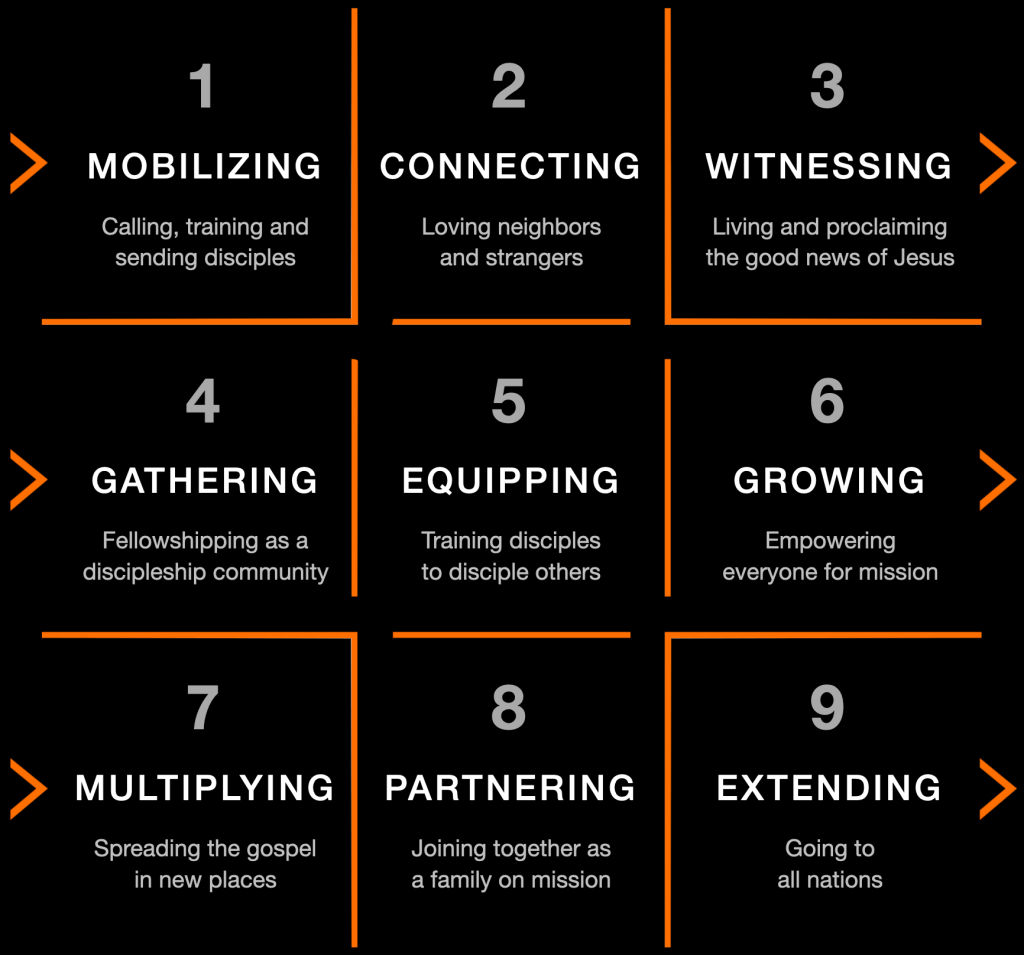
- The group of people is in only one stage at a time.
- it’s a strategy map; they can be engaged in activities all over the place, including scouting out future stages, but there’s only one overall stage that represents where they are as a group, and what their next step is
- You can be involved with different groups of people, so e.g. you can be with your neighbors in stage 2, with your church in stage 5 and at your job at a mission agency in stage 9, but each of those groups are only in one stage.
- Each next stage is like a 90° turn from the previous one. Like tacking in a sail boat, you still have the same destination, but your approach is quite different from one stage to the next. Examples:
- preparing to go vs 2. being there
- serving people practically vs 3. telling them about Jesus
- individuals vs 4. groups (switching rows is a big deal)
- investing in the leader vs 5. about the team
- the church vs 6. the community
- local vs 7. other locations (switching rows is a big deal)
- one leader vs 8. team leadership
- your country vs 9. other nations
- Each stage supports the one above it.
- By column:
- A stage 7 ministry is multiplying by helping stage 4 gatherings to stage 1 mobilize people into mission.
- A stage 8 family of churches supports stage 5 churches equipping their members to connect with their stage 2 neighbors.
- A stage 9 mission agency enables stage 6 growth that helps stage 3 witnessing.
- In each local context, we’re always investing in the bottommost stages. Picture the stages like blocks you can stand on, or if there’s no block, to fall through. Examples:
- If a stage 4 church plant is struggling, we’re first going to the stage 7 church planting network leaders.
- If churches are stuck in stage 4, with everything revolving around one person, we want to work with the stage 8 group who would set them up to succeed at empowering a team in stage 5.
- If someone tries to initiate their own thing in stage 6, and the stage 5 church is pulling them back into their programs, then we’re looking to the stage 9 mission agency to create a foundation for them to step onto.
- By column:
- Stages are typically similar in length. (Of course, not always.)
- You can tell if you’re stuck by examining how long it took you in each of the previous stages. These aren’t comparable with ministries in other places, but it is instructive inside your own context.
- You can tell if you’re going too fast the same way. It doesn’t help to rush. You can pretend you’re further along, but each stage is necessary.
- Stage 9 is doing all the stages over again, but in a different context. So for you it’s the same length, but for them it can be 9x faster, because you’ve done it all before.
- Don’t follow this Map.
- Our job is to follow Jesus. Probably don’t look at the Mission Strategy Map more than once per year. It’s just helpful for reflection and in communicating with others what your challenges are.
 Odd Sense of Zero
Leave a comment